How Family Can Affect the Mental Health of an Individual
The social media platform Instagram fabricated headlines last year for suppressing likes in an try to curb the comparisons and hurt feelings associated with attaching popularity to sharing content. Merely do these efforts combat mental health issues, or are they just applying a rough-and-tumble to a wound?
It's a small step in the right direction, says Jacqueline Sperling, PhD, a psychologist at McLean Hospital who works with youth who experience anxiety disorders, near Instagram's recent restriction. "Even if you remove the likes, there continue to be opportunities for comparisons and feedback. People withal tin can compare themselves to others, and people however can mail service comments."
Lookout Now!
The Risks for the Reward
Social media has a reinforcing nature. Using it activates the brain's reward center by releasing dopamine, a "experience-good chemical" linked to pleasurable activities such equally sex, food, and social interaction. The platforms are designed to be addictive and are associated with anxiety, low, and even physical ailments.
According to the Pew Research Heart, 69% of adults and 81% of teens in the U.South. use social media. This puts a large amount of the population at an increased risk of feeling broken-hearted, depressed, or ill over their social media use.
But what makes users come back for more even when information technology can literally make them experience ill?
"When the outcome is unpredictable, the behavior is more likely to echo," Sperling says. "Call up of a slot machine: if game players knew they never were going to go coin by playing the game, so they never would play. The thought of a potential future advantage keeps the machines in use. The same goes for social media sites. Ane does not know how many likes a picture will become, who will 'like' the moving picture, and when the movie will receive likes. The unknown consequence and the possibility of a desired event can keep users engaged with the sites."
To heave self-esteem and feel a sense of belonging in their social circles, people post content with the promise of receiving positive feedback. Couple that content with the structure of potential future advantage, and yous get a recipe for constantly checking platforms.
When reviewing others' social activity, people tend to make comparisons such every bit, "Did I get as many likes every bit someone else?," or "Why didn't this person like my post, but this other person did?" They're searching for validation on the internet that serves equally a replacement for meaningful connection they might otherwise make in existent life.
FOMO—fear of missing out—also plays a role. If anybody else is using social media sites, and if someone doesn't join in, there's concern that they'll miss jokes, connections, or invitations. Missing experiences can create anxiety and depression. When people look online and encounter they're excluded from an activity, it can touch on thoughts and feelings, and can affect them physically.
A 2018 British study tied social media use to decreased, disrupted, and delayed sleep, which is associated with depression, memory loss, and poor academic performance. Social media use can touch on users' concrete health even more directly. Researchers know the connectedness between the mind and the gut can plow anxiety and low into nausea, headaches, musculus tension, and tremors.
4 Ways to Fight Digital Burnout
Are yous spending also much fourth dimension on your devices? Learn how to spot the signs of screen fatigue and digital burnout.
The Digital Historic period of Vulnerability
The before teens commencement using social media, the greater impact the platforms have on mental health. This is especially true for females. While teen males tend to express aggression physically, females practise so relationally by excluding others and sharing hurtful comments. Social media increases the opportunity for such harmful interactions.
Sperling offers the example of a 7th grader whose all-time friend chooses a new best friend and posts pictures of the pair at the movies or on a weekend trip. "Twenty years agone, the girl may accept been excluded from her best friend's activities, but she may not have known about information technology unless she was told explicitly," Sperling says.
In addition to providing young people with a window through which they can view missed experiences, social media puts a distorted lens on appearances and reality. Facebook, Instagram, and Snapchat increase the likelihood of seeing unrealistic, filtered photos at a time when teen bodies are irresolute.
In the past, teens read magazines that contained altered photos of models. Now, these images are one thumb-ringlet away at any given time. Apps that provide the user with airbrushing, teeth whitening, and more filters are easy to discover and easier to use. Information technology'southward not but celebrities who expect perfect—it's anybody.
When there's a filter applied to the digital world, it tin be hard for teens to tell what's real and what isn't, which comes at a hard time for them physically and emotionally.
"Middle schoolhouse already is challenging for students with all of their developmental changes. Every bit they go through puberty, they're tasked with establishing their identity at a time when the frontal lobes in their brains are not fully adult, and at that place is a lack of impulse control. All of this happens while their relationships with peers become more important," Sperling says. "It'southward a very vulnerable population to have access to something where there is no stopgap earlier they post or press the send push. I call back that's something of which to exist mindful."
Adults are vulnerable, besides. In recent years, plastic surgeons have seen an uptick in requests from patients who want to await similar their filtered Snapchat and Instagram photos. A New York Times article that ran in June 2018 features a newlywed couple who nearly separated after their honeymoon. The reason: the wife spent more time on the trip planning and posting selfies than she spent with her husband.
Self-Care Is Important
McLean develops gratis and reliable mental health resource for the public and professionals to promote healthy individuals and communities.
How Can the Platforms Change?
Sperling acknowledges social platforms have positive aspects, such as their ability to let people to stay in touch with family unit and friends effectually the world. She realizes the potential pitfalls of completely banning teens from sites that have get a function of life for their generation—non just as a way for them to stay on top of contempo parties and conversations only often equally an expected source of announcements and news. Withal, she says, the platforms take opened a "Pandora'due south box" equally they continue to evolve more quickly than we can research their affect.
"I call back we need to take a step back and expect at the office technology is playing in our society as a whole, in terms of people needing instant gratification, staying home and not interacting in the customs by going to local stores or to the moving-picture show theater," she says. "Even dating apps can decrease motivation for single adults to approach others in the community if they think they only can connect with them on an app first."
In addition to limiting likes, as Instagram has washed, Sperling suggests social platforms consider decreasing mass sharing altogether. They might function more as messaging services by highlighting 1-on-ane communications. Regardless of how likely social media giants are to change their ways, though, individuals tin accept command of their own behavior.
Distract Yourself From the Distraction
People aren't usually motivated to change their social media use by merely hearing it's bad for them. Information technology'due south better for individuals to encounter what their limits are. It'southward probably unrealistic for most social media users to quit completely. All the same, they can monitor their behavior to see how their employ impacts them, and how to act every bit a outcome.
Michelle knows this all too well. When she was initially treated for anxiety, her therapist asked her if she was active on social media, and she said yep. "It turns out that a lot of my feet and impostor syndrome is fabricated worse when I'one thousand online." A person experiences impostor syndrome when feeling chronic self-dubiety and a sense of being exposed as 'a fraud' in terms of success and intellect. "Whether it's another pretty vacation or someone'due south boutonniere of flowers, my mind went from 'Why not me?' to 'I don't deserve those things, and I don't know why,' and it made me feel awful."
She and her therapist decided to set basis rules. "If I was to continue using social media, I had to acquire what would trigger my anxiety and how using different platforms made me feel," says Michelle. The result was her deleting Snapchat for skilful, and later 5 years, she still doesn't miss it. She's still active on several other platforms, though.
Sperling encourages people to carry their own behavior experiments by rating their emotions on a scale of 0-10, with 10 being the most intensely 1 could experience an emotion, earlier and after using social media sites at the same time each day for a week. If 1 notices that one feels less happy after using them, then 1 might consider changing how 1 uses social media sites, such as using them for less time and doing other activities that one enjoys instead.
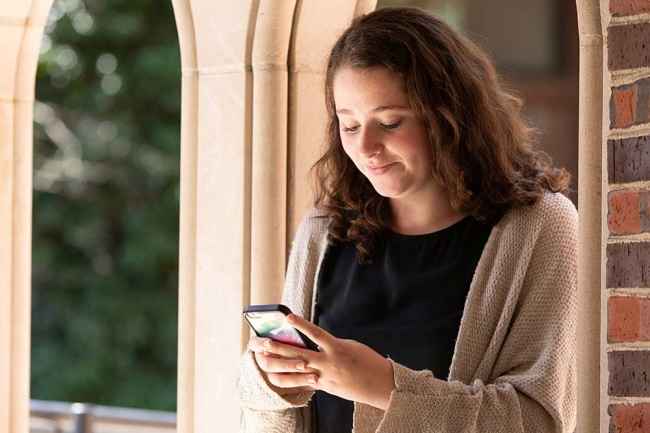
A 2018 University of Pennsylvania study suggests that such cocky-monitoring can modify 1's perception of social media.
The written report's researchers looked at 143 undergraduates randomly assigned to two groups. The first set was asked to limit Facebook, Instagram, and Snapchat to ten minutes per platform per twenty-four hour period, while the second was asked to continue to use their social media as usual for iii weeks. The limited group showed meaning reductions in loneliness and depression during those three weeks over the group that continued using social media.
Both groups showed pregnant decreases in anxiety and fright of missing out compared to where they were at the study'due south kickoff.
"I'd love to say that my use is totally healthy, just I notice that I'g still comparing myself to others," Michelle says. "Now I can recognize what's going to help or injure my mental well-being. My therapist and I agreed that I'd ready limits on my app usage to two hours a day across all platforms. Now I know when it'southward time to log off and take care of myself."
Ready a Skillful Example
Parents tin develop a plan of how much time family unit members will spend on devices. Strategies like these teach kids healthy media use and good sleep hygiene.
When teens start using social media, parents can ask them to plow in their phones at night with the understanding that parents can review posts and messages. This helps parents be in the know, as sometimes immature people will share struggles online while parents have no idea.
Monitoring besides encourages teens to retrieve that everything they share online is a permanent fingerprint. If they don't want their parents to see it, then information technology shouldn't be posted.
Sperling suggests that some families modify the means they utilize social media. Try a "no selfie" policy or a rule that kids can post pictures of tangible objects just no photos of themselves. This fashion, children tin share their experiences without emphasizing a focus on their advent.
A common argument is when children say they are missing out considering of restrictions placed on their telephone use—that they aren't immune on a platform or tin can't be online later on a certain fourth dimension.
"Parents' frequency of electronics use tin fix the tone for what is permissible to their children. If yous want your children to put their phones down at dinner, that will be more likely to happen if you practise the aforementioned."– Dr. Jacqueline Sperling
Sperling tells parents to remind kids that a skilful friend would notice a style to spend fourth dimension with them. She suggests other ways for kids to talk to one another to continue those feelings of FOMO abroad and exist socially present. "If adolescents know that they cannot use their telephone after a certain fourth dimension or are not allowed to admission a site that their friends employ, then they tin ask their friends to permit them know of whatsoever plans made when they see each other at school or phone call the house phone or 1 of the parent'southward phones and so that they tin remain included."
Of course, Sperling says, the mode parents are using social media is the model for their kids. A University of Texas review of research on parents' use of mobile devices while interacting with their children found that mobile use contributed to distracted parenting, an increase of bids for attention when the parents were distracted, and conflicts with other caregivers.
"Parents' frequency of electronics utilise can set the tone for what is permissible to their children," Sperling says. "If you want your children to put their phones down at dinner, that will be more likely to happen if you practice the same."
Source: https://www.mcleanhospital.org/essential/it-or-not-social-medias-affecting-your-mental-health

Post a Comment for "How Family Can Affect the Mental Health of an Individual"