When Section 8 Will Open Again
(*This post may comprise affiliate links, which means I may receive a small committee if you cull to purchase through the links I provide (at no extra price to you). Thank y'all for supporting the work I put into this site!)
Graphics Card running at x8 instead of x16 is i of the about annoying problems that a graphics carte user can run across. Just to tell you, I take likewise faced this trouble and it was actually frustrating to detect the cause considering it takes into account all the factors related to the motherboard, operating system, and the graphics menu. Sometimes, it may not be a trouble at all and but a misunderstanding, because, at low GPU loads, the PCIe omnibus runs at lower speeds to conserve power, which is also a office of the power direction features in windows, and at higher GPU loads, information technology switches to higher PCIe mode to evangelize maximum functioning needed by the games or applications
Commonly, at low loads, the PCIe x16 coach runs at PCIe x16 1.1 and equally the load increases, information technology goes to high bandwidth state which is generally PCIe x16 3.0, bold that your graphics, CPU, and motherboard supports PCIe three.0 standard. So, if the PCIe x16 bus switches from PCIe x16 1.1 land to PCIe x16 3.0 as the load increases, and then you don't have to worry virtually at all, because everything is working properly equally expected. The point of concern is when your graphics card is capable of running at PCIe x16 3.0 but is running at PCIe x8 1.ane or PCIe x8 3.0, fifty-fifty at full GPU load. For instance, in the paradigm beneath, you can clearly come across that the graphics card is only utilizing x8 lanes and is non working at its full chapters, which is at x16, even though the PCIe standard is switching from PCIe 1.1 to PCIe 3.0.
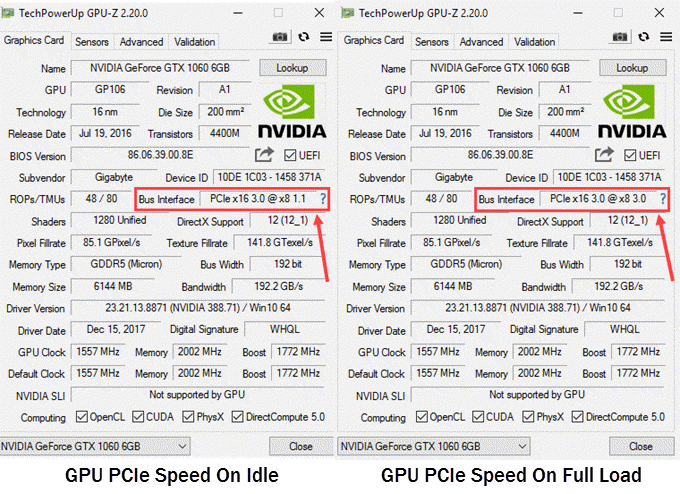
There can exist several reasons that can pb to this trouble, and in some cases, at that place is no definite respond to it. Sometimes, the issue is related to hardware and sometimes it may exist due to firmware and software, but in most cases, the upshot lies with the hardware simply. If y'all are lucky, then you can resolve this issue in minutes but if y'all are not then it can accept a lot of attempt and time to effigy out the exact cause of this problem. In some cases, you may have to live with this problem, considering it cannot be fixed due to the faulty hardware. So, here I am going to list downwards the various factors that tin can contribute to this problem, along with their solutions or fixes.
How to Cheque and Verify GPU PCIe Speed?
The best and the easiest way to check that your graphics card is operating at full PCI Express speed and is using all the 16x lanes is past using the GPU-Z, which is the all-time graphics card information utility. It has a congenital-in rendering test that pushes the GPU load to 100% and lets you bank check whether the Graphics Bill of fare or PCIe interface is operating at its maximum potential or not. To test this, download the GPU-Z utility and run it. Now, in the Passenger vehicle Interface section you will meet the maximum PCIe double-decker interface supported past the graphics card, and forth its side, the i that information technology is currently working on. Below, you tin encounter that the graphics bill of fare supports PCIe x16 iii.0 but is working on PCIe x8 ane.1 to save power when the GPU is idle or the GPU load is minimum. Now, click on the question mark next to it. A new window will open along the side, on which there is the Start Render Examination push button. Click on the Commencement Render Test push and this volition showtime a GPU render test that will put your GPU usage to 99% or 100%.
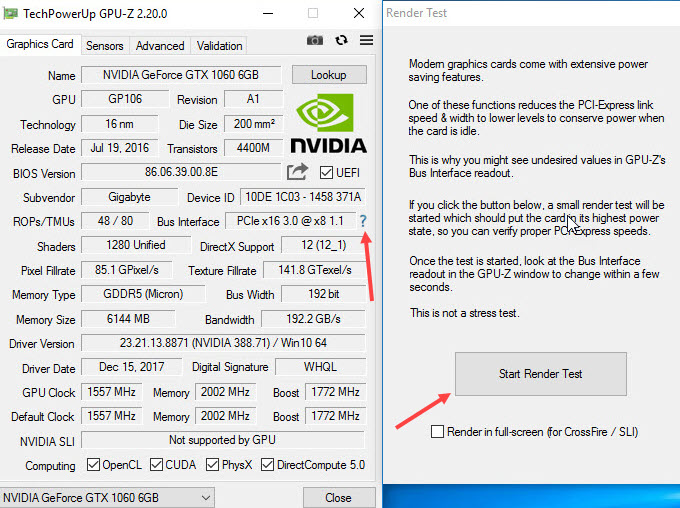
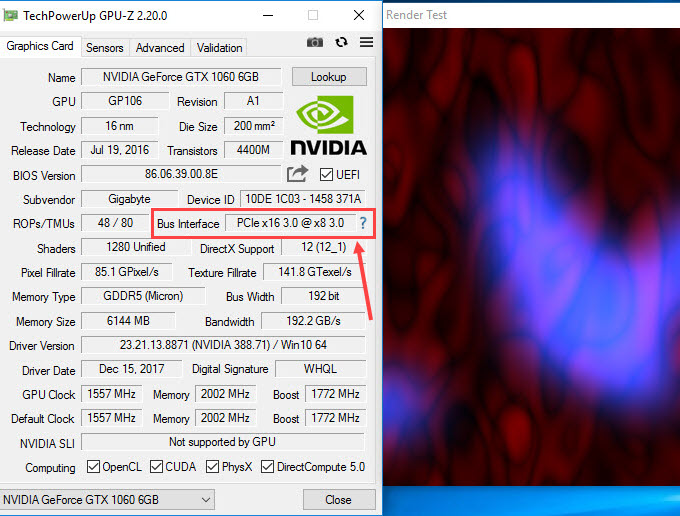
Now, if the PCIe Bus Interface changes from PCIe x8 i.one to PCIe x16 3.0, then information technology means your PCIe double-decker interface is operating at full bandwidth and speed. Nonetheless, if it changes to PCIe x8 3.0 or remains at PCIe x16 one.1 merely, then it is an effect and y'all have to find the crusade of it.
Notation: In the above scenarios, both the graphics carte and motherboard supports PCIe iii.0 x16 interface.
How much operation loss can be in that location?
If your PCIe x16 motorbus is working at PCIe x8 at full GPU load, instead of x16 (both PCIe three.0), so you normally don't have to worry near the operation every bit such. This is considering even if yous accept a loftier-terminate graphics card like GTX 1080 Ti then as well it will be nearly incommunicable for it to saturate the PCIe 3.0 x8 bus when information technology is running at its maximum performance or capacity. Nonetheless, y'all may run into a tiny operation loss in some applications or games, which is around 1% to 2% at max. However, you can suffer significant performance loss so the graphics card runs at PCIe 1.ane x8, PCIe ii.0 x8 or at PCIe iii.0 x4, given that both the graphics card and motherboard are PCIe iii.0 x16 capable.
Why GPU / PCIe running at x8 instead of x16?
Here are the diverse causes (with their solutions) that tin make your graphics card to run at x8 instead of x16 in your PCIe x16 slot.
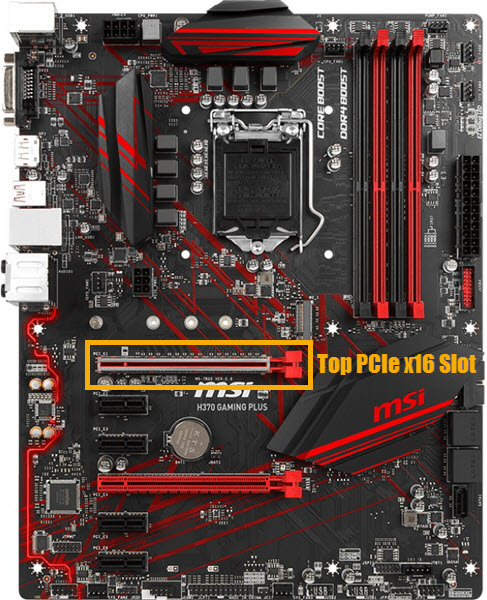
GPU not in the top PCI-Due east x16 slot
The kickoff affair to exercise is to check whether you take the graphics card is installed in the commencement PCI-Eastward x16 slot, because if you take 2 or more than than one PCIs x16 slots and then in most of the motherboards, the first PCIe x16 slot runs at maximum PCIe bandwidth, which is x16, while the second PCI-Due east x16 slot runs at x8 speed merely.
Check if CPU, GPU & Motherboard supports PCIe x16
You also have to make sure that your CPU, Motherboard and GPU support PCIe x16, whether information technology is a PCIe 3.0 or PCIe two.0 standard. You can check this data on the manufacturer's website of the CPU, motherboard and graphics card. If your CPU does not have PCIe sixteen lanes so your GPU won't run on PCIe x16 speed, fifty-fifty if the motherboard supports it. On the other hand, if the CPU supports PCIe x16 lanes for the graphics menu, but your motherboard or graphics menu is limited to only PCIe x8, so your graphics bill of fare will run at PCIe x8 only.
Reseat the graphics card
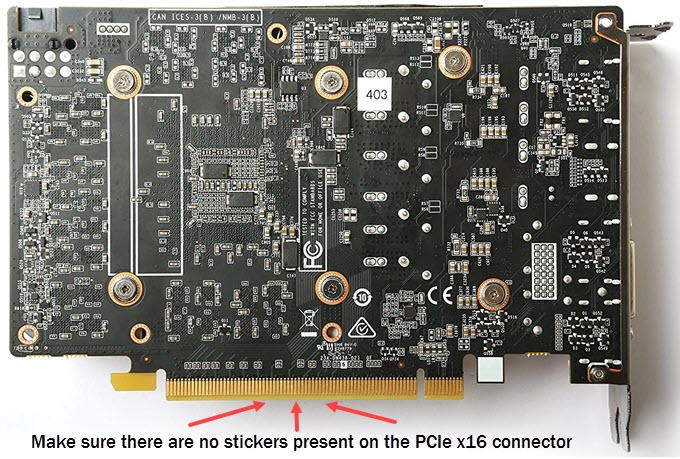
One of the virtually of import things to practise, when y'all face this problem is to reseat your graphics card. Remove the graphics card from the PCI-E x16 slot, clean the PCI-Eastward connector contacts with isopropyl alcohol and put it back in the PCI-E x16 slot properly. This is because, sometimes dust or even some function of the warranty sticker can be nowadays on the PCI-E connector, which can result in this upshot. Also, brand certain that the motherboard PCI-E x16 slot is clean and there is no dust present in it. Y'all can clean off the dust using an electric air duster by blowing air on the PCIe x16 slot.
Multi-GPU Setup [SLI or CrossFire]
If you take two graphics cards installed in SLI or CrossFire multi-GPU style, then the graphics cards will run at PCIe x8 simply, considering the CPU PCIe x16 lanes become shared betwixt the two cards as, fifty-fifty if the first PCI-Limited slot supports 16 PCIe lanes.
PCI-E Lanes shared with other Components
[NVMe SSD or PCI-E x16 Expansion cards]
If you take PCIe NVMe SSD installed in your computer, then information technology might be possible that the NVMe SSD is consuming some of the PCIe lanes of the CPU, and this will upshot in your graphics card to run at lower PCIe x8 speed. This can happen with some motherboards where the chipset PCIe lanes are not configured to be utilized for NVMe SSDs. So, hither you tin remove the NVMe SSD from the M.2 slot to cheque that whether your graphics card is now operating at full PCIe x16 speed or not. This upshot tin can likewise happen if you lot have a PCIe expansion card (sound carte du jour etc.) in the adjacent PCIe slot, which is eating up your PCI Express lanes and making your graphics bill of fare run at PCIe x8. So, here likewise, you tin remove the PCIe expansion carte du jour and can cheque whether the PCIe status of the graphics carte du jour reverts to the PCIe x16 or not.
PCI-E power cablevision plugged in graphics carte du jour
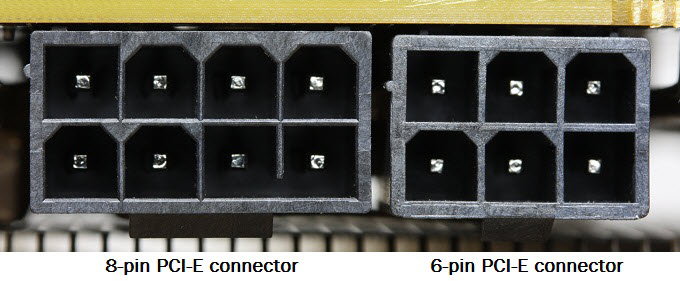
If your graphics bill of fare requires external PCIe ability connectors (half dozen-pivot/8-pin) then make sure that they are plugged in properly and besides that the connectors are working fine. In most cases, if the half-dozen-pin / 8-pin PCIe connector is not connected or is faulty and then your computer won't boot, simply in some cases, the graphics bill of fare may work but will operate at much lower speeds. And so, continue this little thing in mind and check your Ability Supply PCI-Express power connector also, when your graphics carte du jour is operating at PCIe x8 instead of PCIe x16.
Disable USB three.0 Turbo in BIOS
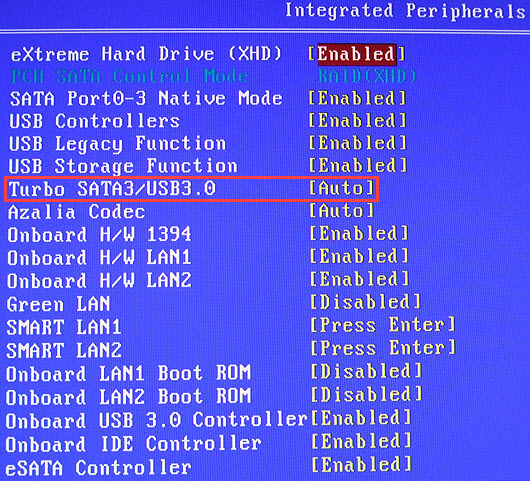
If yous have a motherboard that has Turbo USB 3.0 or USB 3.0 Turbo choice in the BIOS then disable information technology, considering Turbo USB 3.0 characteristic consumes your CPU PCIe lanes at the expense of some extra boost in USB 3.0 speed, and makes your graphics card run at PCIe x8 speed only. Yous can notice this 'Turbo USB 3.0' feature implemented in many of the Gigabyte Motherboards. You tin can find this option in the BIOS, nether the Integrated Peripheral department, and hither you can disable it safely.
Update Motherboard BIOS
If your motherboard BIOS is outdated and a new update is available from the motherboard manufacturer, and so you can update your motherboard BIOS to see if the problem is not related to the BIOS. Also, updating your motherboard BIOS is a good thing because information technology can take security fixes, problems fixes, new features and support for newer hardware. Updating the motherboard BIOS is very like shooting fish in a barrel and you can do it past using a USB Flash bulldoze. You lot can download the latest BIOS for your motherboard from the manufacturer'due south website and can consult the manual for instructions on how to flash or update it.
Update Graphics Card BIOS
Yous may likewise try updating the GPU BIOS, but do this only when you have the right copy of the updated BIOS of your graphics carte du jour, and you lot take tried all the other things. This is a risky thing to practice because a slight error on your side can brick your graphics carte du jour for life. Mostly, I do not advise updating the GPU BIOS, and information technology should only be done when you lot have some serious problems with your graphics card and this is but the last resort when you have tried everything else.
Must Read: GPU BIOS Update Tools & How to Update GPU BIOS
Windows PCI-E link country power management
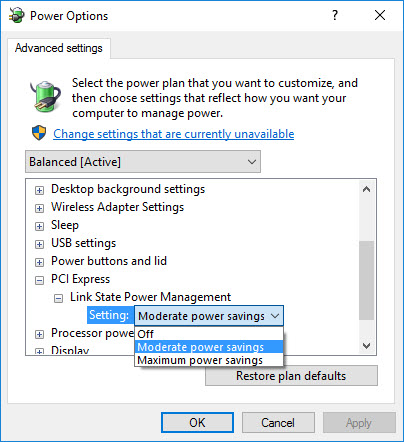
Make sure that your PCI Express Link Country Power Management setting is non fix to Maximum power settings. You lot can check this past going to Control Panel->Power Options->Change plan settings (for the selected plan)-> Change advanced power settings->Expand PCI Express option->Link State Power Direction->Setting. Here, select Off or Moderate power setting, if the Maximum power savings option is selected earlier.
Reseat CPU and Make clean Pins / Contacts
Yous can also check whether your CPU / Motherboard pins are clean and there is nothing obstructing them. This is because I have seen in some cases where if one of the pins is dirty and not making contact with the CPU and motherboard, then all the CPU PCIe lanes may not be bachelor for the graphics carte du jour, and this tin can cause your GPU to run at lower PCIe x8 speed instead of x16.
Install Chipset & Video drivers
Clean install the video drivers past removing the older ones using Display Driver Uninstaller (DDU) utility to check whether the issue is from the driver side or non. You lot can likewise install the latest chipset drivers for your motherboard to confirm that it is not a driver related event.
Faulty Motherboard
A faulty motherboard can besides be a cause of this issue and you cannot practice annihilation in this case, other than replacing the motherboard itself. To check whether the culprit is the motherboard, you can try running your graphics bill of fare in some other PC (friend's PC or other), and if the card runs at total PCIe x16 speed in that system, then the issue is with the motherboard just, given that y'all accept already tried all the above-mentioned solutions. If the motherboard is nether warranty, and so you can enquire for a replacement from the seller.
Faulty Graphics card
Like a faulty motherboard, the graphics card can too be faulty. This you can check past running your graphics carte du jour in another system that supports PCIe x16, and if the carte du jour yet runs at PCIe x8, and then most likely the issue is with the card. Hither, y'all can either supervene upon the card if information technology is nether warranty or go on information technology because if the carte is running at PCIe 3.0 x8 speed, then the performance loss volition exist close to negligible (1% to 2% max). In my instance, the event is with the graphics card, which is Gigabyte GeForce GTX 1060 WINDFORCE OC 6G, and I chose to keep information technology and live with it, because it is not worth worrying and I am getting the total operation out of it, even at PCIe three.0 x8.
Encounter also:
- Graphics Card Troubleshooting Guide
- Fix Graphics Card Non Detected Problem
Whatever Queries?
If you have some queries regarding this result or want to share your stance and feedback, then you can connect with me using the comment department beneath.
Source: https://graphicscardhub.com/gpu-pcie-running-x8/

Post a Comment for "When Section 8 Will Open Again"