How Do I Upload a Document Into Amazon S3 - What Format Do I Use
When working with Amazon S3 (Unproblematic Storage Service), you're probably using the S3 web panel to download, copy, or upload files to S3 buckets. Using the console is perfectly fine, that'southward what it was designed for, to begin with.
Particularly for admins who are used to more mouse-click than keyboard commands, the web console is probably the easiest. Withal, admins will eventually come across the need to perform bulk file operations with Amazon S3, like an unattended file upload. The GUI is not the best tool for that.
For such automation requirements with Amazon Web Services, including Amazon S3, the AWS CLI tool provides admins with command-line options for managing Amazon S3 buckets and objects.
In this article, you will acquire how to use the AWS CLI command-line tool to upload, copy, download, and synchronize files with Amazon S3. You volition also acquire the nuts of providing admission to your S3 bucket and configure that access profile to work with the AWS CLI tool.
Prerequisites
Since this a how-to commodity, there will be examples and demonstrations in the succeeding sections. For you to follow along successfully, you volition need to meet several requirements.
- An AWS business relationship. If you don't accept an existing AWS subscription, you can sign upwardly for an AWS Free Tier.
- An AWS S3 bucket. Y'all can use an existing bucket if you'd prefer. Still, information technology is recommended to create an empty bucket instead. Please refer to Creating a bucket.
- A Windows 10 computer with at least Windows PowerShell 5.1. In this article, PowerShell 7.0.2 will be used.
- The AWS CLI version ii tool must be installed on your computer.
- Local folders and files that you will upload or synchronize with Amazon S3
Preparing Your AWS S3 Access
Suppose that you already take the requirements in place. You'd think you can already get and offset operating AWS CLI with your S3 bucket. I mean, wouldn't it be nice if it were that simple?
For those of you lot who are merely beginning to work with Amazon S3 or AWS in general, this section aims to help y'all set access to S3 and configure an AWS CLI profile.
The full documentation for creating an IAM user in AWS tin can exist found in this link beneath. Creating an IAM User in Your AWS Account
Creating an IAM User with S3 Admission Permission
When accessing AWS using the CLI, y'all will need to create 1 or more IAM users with enough access to the resources y'all intend to work with. In this section, you lot will create an IAM user with access to Amazon S3.
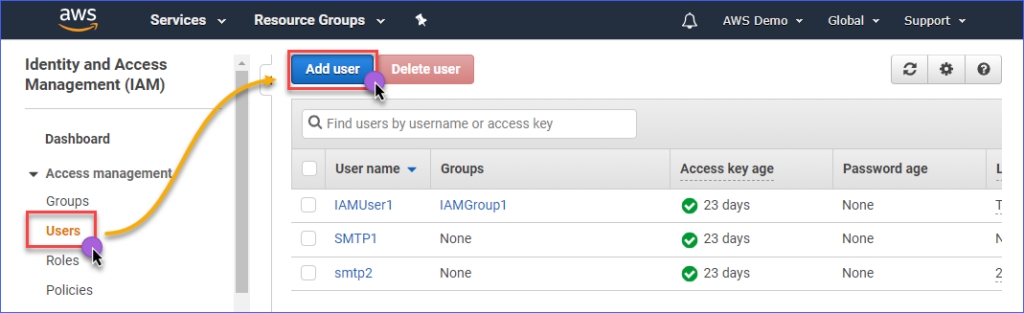
To create an IAM user with admission to Amazon S3, you first need to login to your AWS IAM console. Under the Access management grouping, click on Users. Next, click on Add user.
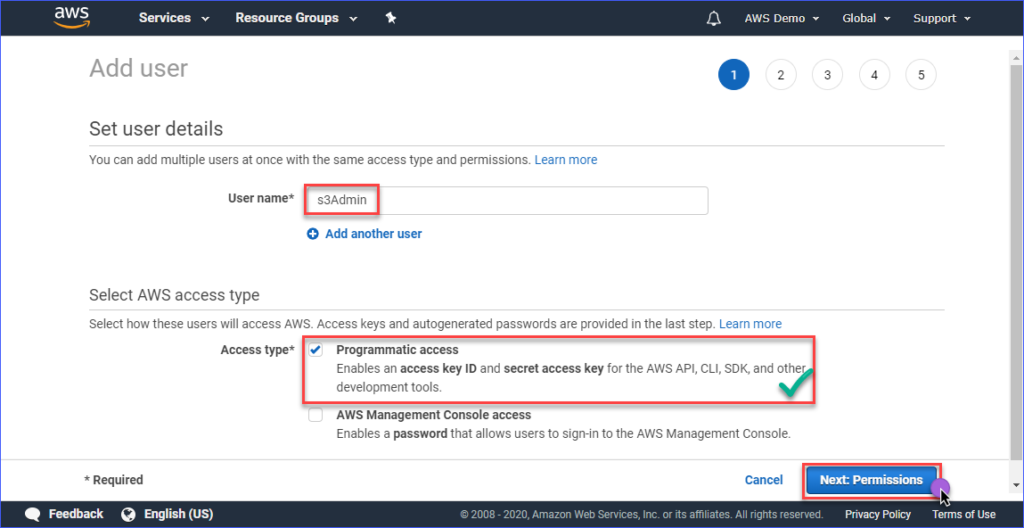
Type in the IAM user's proper name you are creating inside the User name* box such as s3Admin. In the Access type* selection, put a check on Programmatic access. Then, click the Next: Permissions push button.
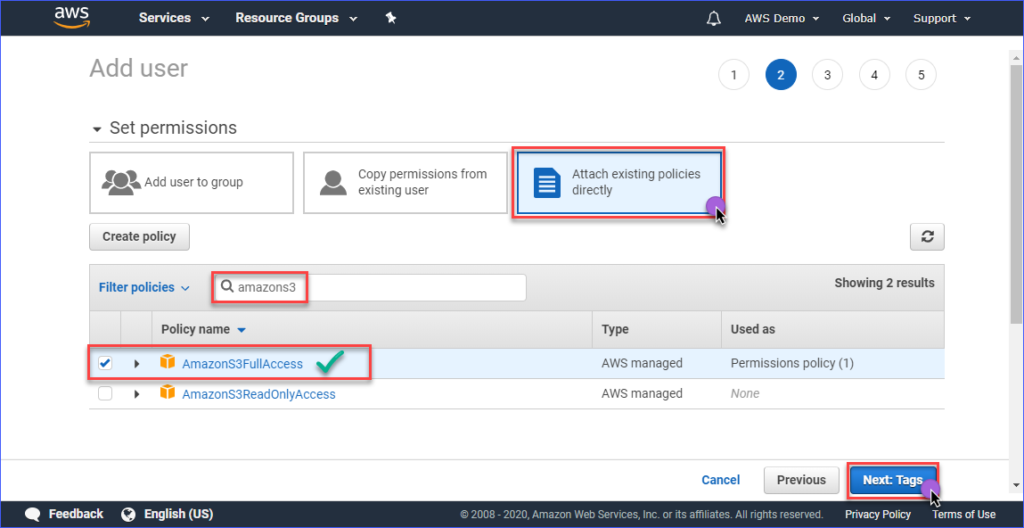
Adjacent, click on Adhere existing policies straight. And then, search for the AmazonS3FullAccess policy name and put a check on it. When done, click on Adjacent: Tags.
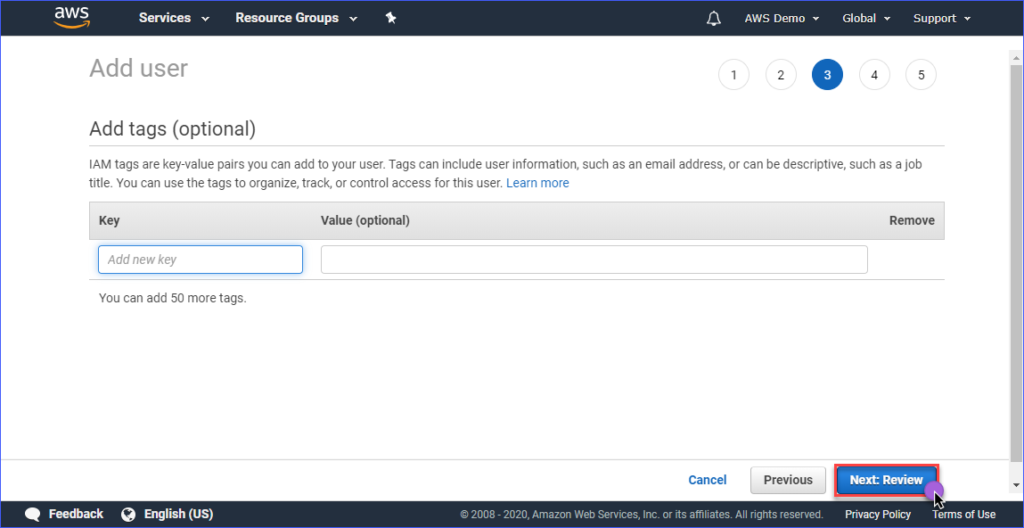
Creating tags is optional in the Add tags page, and you can just skip this and click on the Next: Review push.
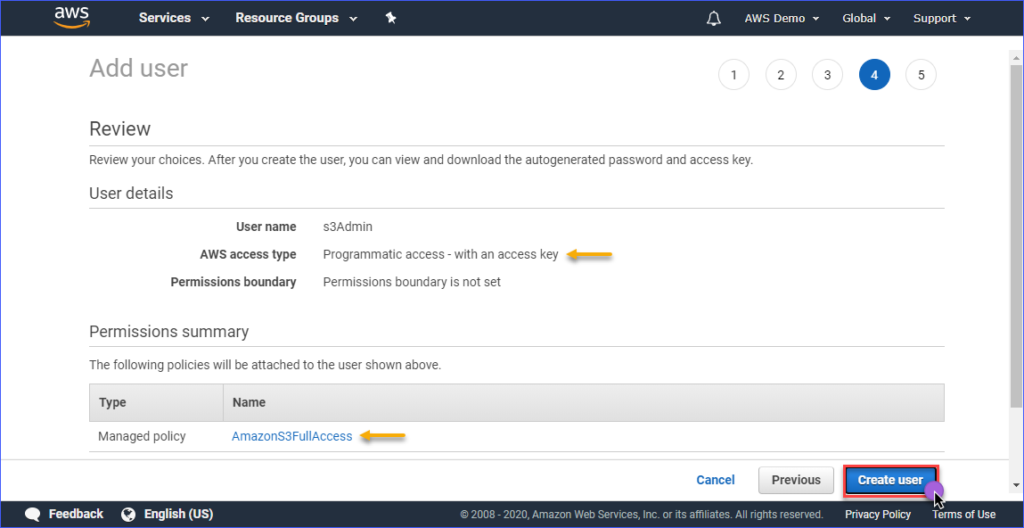
In the Review page, yous are presented with a summary of the new account being created. Click Create user.
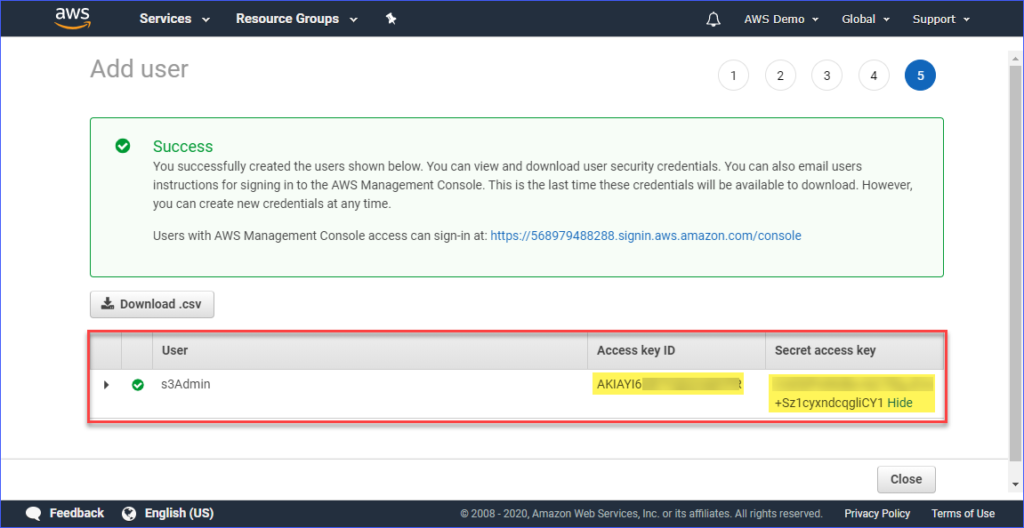
Finally, once the user is created, you must copy the Admission key ID and the Hugger-mugger admission key values and relieve them for later user. Note that this is the only time that you can see these values.
Setting Up an AWS Profile On Your Estimator
Now that you've created the IAM user with the appropriate access to Amazon S3, the next stride is to set up the AWS CLI contour on your computer.
This department assumes that you lot already installed the AWS CLI version 2 tool as required. For the profile cosmos, you volition need the following data:
- The Admission cardinal ID of the IAM user.
- The Secret access key associated with the IAM user.
- The Default region name is respective to the location of your AWS S3 saucepan. You can check out the list of endpoints using this link. In this article, the AWS S3 saucepan is located in the Asia Pacific (Sydney) region, and the corresponding endpoint is ap-southeast-2.
- The default output format. Use JSON for this.
To create the profile, open PowerShell, and type the command below and follow the prompts.
Enter the Access key ID, Clandestine access key, Default region name, and default output name. Refer to the demonstration below.

Testing AWS CLI Access
After configuring the AWS CLI contour, you tin confirm that the profile is working past running this command below in PowerShell.
The control above should list the Amazon S3 buckets that you have in your account. The sit-in beneath shows the command in action. The event shows that list of bachelor S3 buckets indicates that the profile configuration was successful.

To learn well-nigh the AWS CLI commands specific to Amazon S3, you tin can visit the AWS CLI Control Reference S3 page.
Managing Files in S3
With AWS CLI, typical file management operations tin be washed like upload files to S3, download files from S3, delete objects in S3, and copy S3 objects to another S3 location. It's all just a matter of knowing the right control, syntax, parameters, and options.
In the post-obit sections, the environment used is consists of the post-obit.
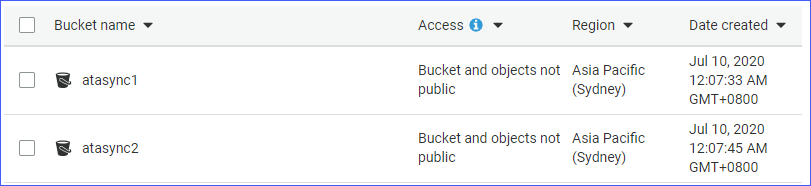
- Two S3 buckets, namely atasync1and atasync2. The screenshot below shows the existing S3 buckets in the Amazon S3 console.
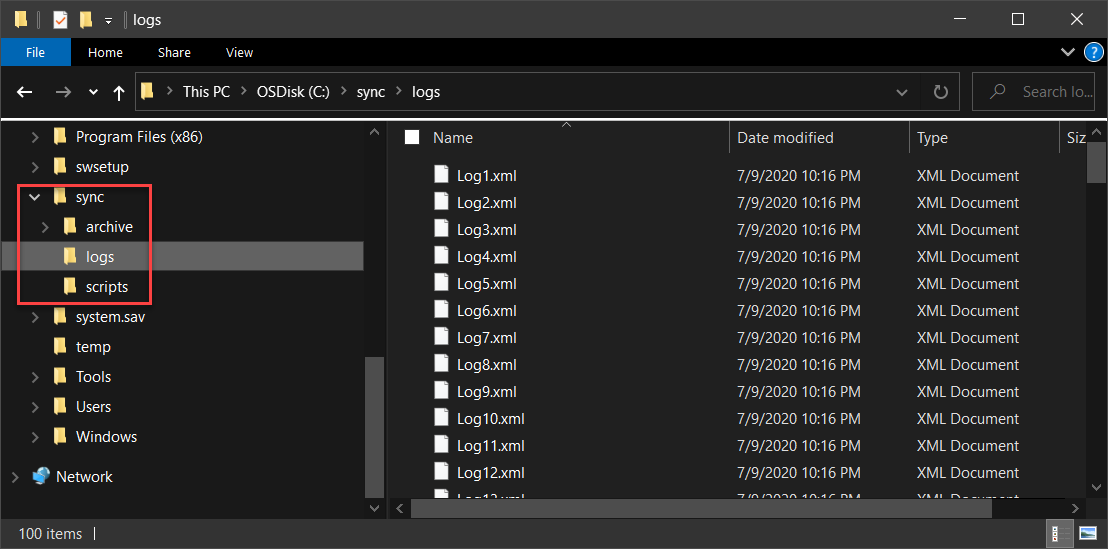
- Local directory and files located under c:\sync.
Uploading Individual Files to S3
When you upload files to S3, you tin upload one file at a time, or past uploading multiple files and folders recursively. Depending on your requirements, you may choose one over the other that yous deem advisable.
To upload a file to S3, yous'll need to provide two arguments (source and destination) to the aws s3 cp control.
For example, to upload the file c:\sync\logs\log1.xml to the root of the atasync1 saucepan, you can use the command below.
aws s3 cp c:\sync\logs\log1.xml s3://atasync1/ Note: S3 saucepan names are always prefixed with S3:// when used with AWS CLI
Run the higher up command in PowerShell, only change the source and destination that fits your environs showtime. The output should look like to the demonstration below.

The demo above shows that the file named c:\sync\logs\log1.xml was uploaded without errors to the S3 destination s3://atasync1/.
Utilise the command below to list the objects at the root of the S3 bucket.
Running the command higher up in PowerShell would result in a similar output, as shown in the demo below. As you can run into in the output below, the file log1.xml is present in the root of the S3 location.

Uploading Multiple Files and Folders to S3 Recursively
The previous department showed you how to copy a single file to an S3 location. What if yous need to upload multiple files from a folder and sub-folders? Surely you lot wouldn't want to run the same control multiple times for dissimilar filenames, correct?
The aws s3 cp control has an selection to process files and folders recursively, and this is the --recursive option.
As an example, the directory c:\sync contains 166 objects (files and sub-folders).
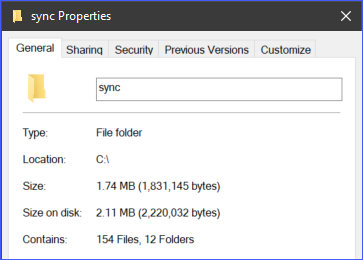
Using the --recursive option, all the contents of the c:\sync folder volition be uploaded to S3 while also retaining the folder construction. To test, use the example code below, merely make sure to modify the source and destination advisable to your surround.
You'll observe from the code below, the source is c:\sync, and the destination is s3://atasync1/sync. The /sync central that follows the S3 bucket proper name indicates to AWS CLI to upload the files in the /sync binder in S3. If the /sync binder does non exist in S3, it volition be automatically created.
aws s3 cp c:\sync s3://atasync1/sync --recursive The code higher up will upshot in the output, as shown in the sit-in below.

Uploading Multiple Files and Folders to S3 Selectively
In some cases, uploading ALL types of files is non the best option. Similar, when you lot only need to upload files with specific file extensions (e.g., *.ps1). Another two options available to the cp command is the --include and --exclude.
While using the command in the previous section includes all files in the recursive upload, the command below volition include only the files that friction match *.ps1 file extension and exclude every other file from the upload.
aws s3 cp c:\sync s3://atasync1/sync --recursive --exclude * --include *.ps1 The demonstration below shows how the code above works when executed.

Another example is if yous desire to include multiple different file extensions, you lot will need to specify the --include selection multiple times.
The example control beneath will include merely the *.csv and *.png files to the re-create command.
aws s3 cp c:\sync s3://atasync1/sync --recursive --exclude * --include *.csv --include *.png Running the code higher up in PowerShell would nowadays you lot with a similar result, as shown below.

Downloading Objects from S3
Based on the examples y'all've learned in this section, you can too perform the copy operations in reverse. Meaning, you tin download objects from the S3 bucket location to the local machine.
Copying from S3 to local would require yous to switch the positions of the source and the destination. The source being the S3 location, and the destination is the local path, similar the 1 shown beneath.
aws s3 cp s3://atasync1/sync c:\sync Annotation that the aforementioned options used when uploading files to S3 are also applicable when downloading objects from S3 to local. For example, downloading all objects using the command beneath with the --recursive option.
aws s3 cp s3://atasync1/sync c:\sync --recursive Copying Objects Betwixt S3 Locations
Autonomously from uploading and downloading files and folders, using AWS CLI, you tin also copy or move files between two S3 bucket locations.
You'll find the control below using ane S3 location as the source, and another S3 location as the destination.
aws s3 cp s3://atasync1/Log1.xml s3://atasync2/ The sit-in below shows y'all the source file existence copied to another S3 location using the control above.

Synchronizing Files and Folders with S3
Y'all've learned how to upload, download, and copy files in S3 using the AWS CLI commands so far. In this section, you'll learn about one more file operation control bachelor in AWS CLI for S3, which is the sync command. The sync command simply processes the updated, new, and deleted files.
There are some cases where y'all demand to continue the contents of an S3 bucket updated and synchronized with a local directory on a server. For example, you may have a requirement to proceed transaction logs on a server synchronized to S3 at an interval.
Using the command below, *.XML log files located under the c:\sync folder on the local server will be synced to the S3 location at s3://atasync1.
aws s3 sync C:\sync\ s3://atasync1/ --exclude * --include *.xml The demonstration below shows that after running the command to a higher place in PowerShell, all *.XML files were uploaded to the S3 destination s3://atasync1/.

Synchronizing New and Updated Files with S3
In this next instance, it is causeless that the contents of the log file Log1.xml were modified. The sync command should pick up that modification and upload the changes done on the local file to S3, as shown in the demo below.
The control to use is however the aforementioned as the previous example.

As you can see from the output to a higher place, since only the file Log1.xml was changed locally, it was also the just file synchronized to S3.
Synchronizing Deletions with S3
By default, the sync control does not procedure deletions. Whatever file deleted from the source location is not removed at the destination. Well, not unless you use the --delete option.
In this next case, the file named Log5.xml has been deleted from the source. The control to synchronize the files volition be appended with the --delete choice, as shown in the code below.
aws s3 sync C:\sync\ s3://atasync1/ --exclude * --include *.xml --delete When you run the control above in PowerShell, the deleted file named Log5.xml should also be deleted at the destination S3 location. The sample issue is shown below.

Summary
Amazon S3 is an splendid resources for storing files in the cloud. With the apply of the AWS CLI tool, the way you apply Amazon S3 is further expanded and opens the opportunity to automate your processes.
In this article, y'all've learned how to use the AWS CLI tool to upload, download, and synchronize files and folders betwixt local locations and S3 buckets. You've likewise learned that S3 buckets' contents can besides be copied or moved to other S3 locations, too.
In that location can exist many more than utilize-instance scenarios for using the AWS CLI tool to automate file management with Amazon S3. You tin can even attempt to combine it with PowerShell scripting and build your own tools or modules that are reusable. It is up to you to notice those opportunities and testify off your skills.
Further Reading
- What Is the AWS Control Line Interface?
- What is Amazon S3?
- How To Sync Local Files And Folders To AWS S3 With The AWS CLI
Source: https://adamtheautomator.com/upload-file-to-s3/

Post a Comment for "How Do I Upload a Document Into Amazon S3 - What Format Do I Use"